| Tank | Tankless | |
|---|---|---|
| Hot water supply | Limited to the tank, then recovery time | Continuous, limited by flow rate |
| Energy use | Keeps a tank hot all day | Heats only when you use water |
| Upfront cost | Lower | Higher, mainly gas line and venting |
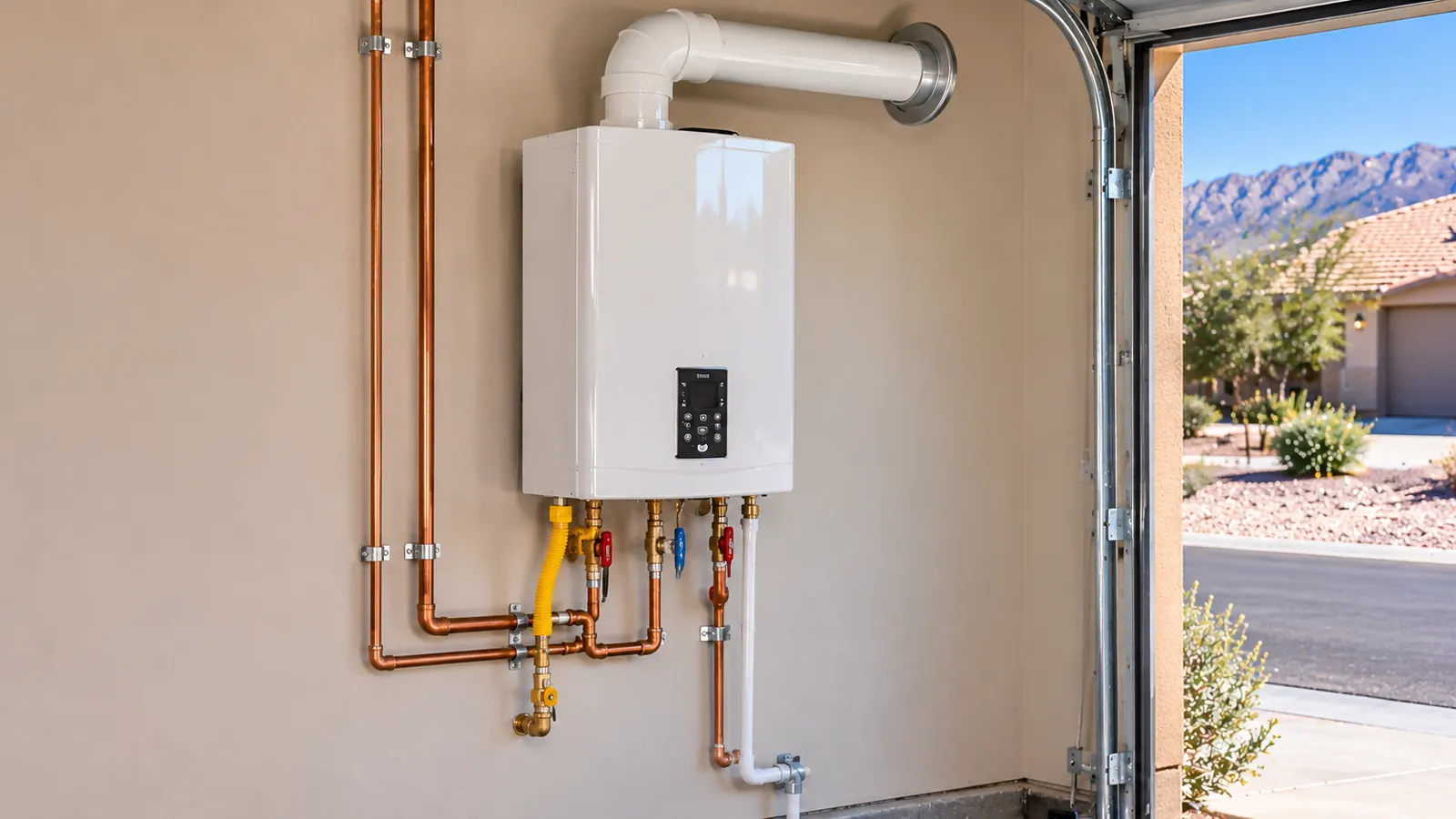
| Space | Floor space for a tall tank | Compact, wall-mounted |
| Hard water | Sediment builds in the tank; flush yearly | Scale builds in the heat exchanger; descale periodically |
| Failure mode | Tank can rust through and leak | No tank to burst; parts can fail |
| Rebates | NMGC rebate on qualifying gas tanks | Larger NMGC rebate on qualifying gas tankless |
Choose a tank if
- You want the lowest upfront cost
- Your hot water use is modest and predictable
- Upgrading the gas line or venting isn't practical
Choose tankless if
- You run out of hot water now
- You want floor space back
- You plan to stay in the house long enough to recover the higher install cost
The Albuquerque factors
Hard water matters for both. Tanks fill with sediment and tankless heat exchangers collect scale, so plan for maintenance either way. Gas units at our elevation need to be the right model and set up correctly. Winter inlet water is colder, so tankless units have to be sized for January, not July.
See tankless installation or tank replacement.
Questions we hear
Is tankless better in hard water?
Tankless units handle hard water well if they're descaled regularly. Without maintenance, scale reduces performance.
Will tankless lower my gas bill?
It removes the standby loss of keeping a tank hot. How much you save depends on how much hot water you use.
Can tankless keep up with two showers at once?
A properly sized unit can. Sizing is based on flow rate and winter water temperature.